
The knowledge already existed
Professional-services firms create knowledge constantly. A subject expert records a training session. A process owner prepares a guide. A manager explains a difficult case. A regulatory notification changes an important procedure. A technical framework is revised and the implications are discussed with a team.
Much of this knowledge is valuable. Yet its useful life is often surprisingly short.
Videos sit in shared folders. Documents are circulated by email and become difficult to find. Long presentations are delivered once, then rarely revisited. Employees who attended a session may remember its broad message, while colleagues who could not attend are left with the source material and little guidance on what matters most.
Across two professional-services organisations, this was the opportunity: not to create an entirely new body of training content, but to make better use of knowledge that already existed.
The problem was not a lack of knowledge. It was that useful knowledge had no reliable route into everyday learning.
When valuable content becomes invisible
The organisations had internally produced training videos, documents and process material developed by people who understood the work. These resources contained practical experience that generic course libraries could not easily reproduce.
But the form of the material made it hard to use consistently.
A complete recording asks an employee to find time to watch it from beginning to end. A detailed process document may be necessary as a reference but difficult to absorb as training. A presentation may explain a change well in the room, but offer little reinforcement afterwards.
Over time, this creates a familiar paradox: the organisation has plenty of content, yet employees still struggle to locate a concise explanation when they need one.
The first task was therefore not simply migration. It was transformation—taking the substance of existing material and reshaping it into smaller, purposeful learning experiences.
From source material to usable learning
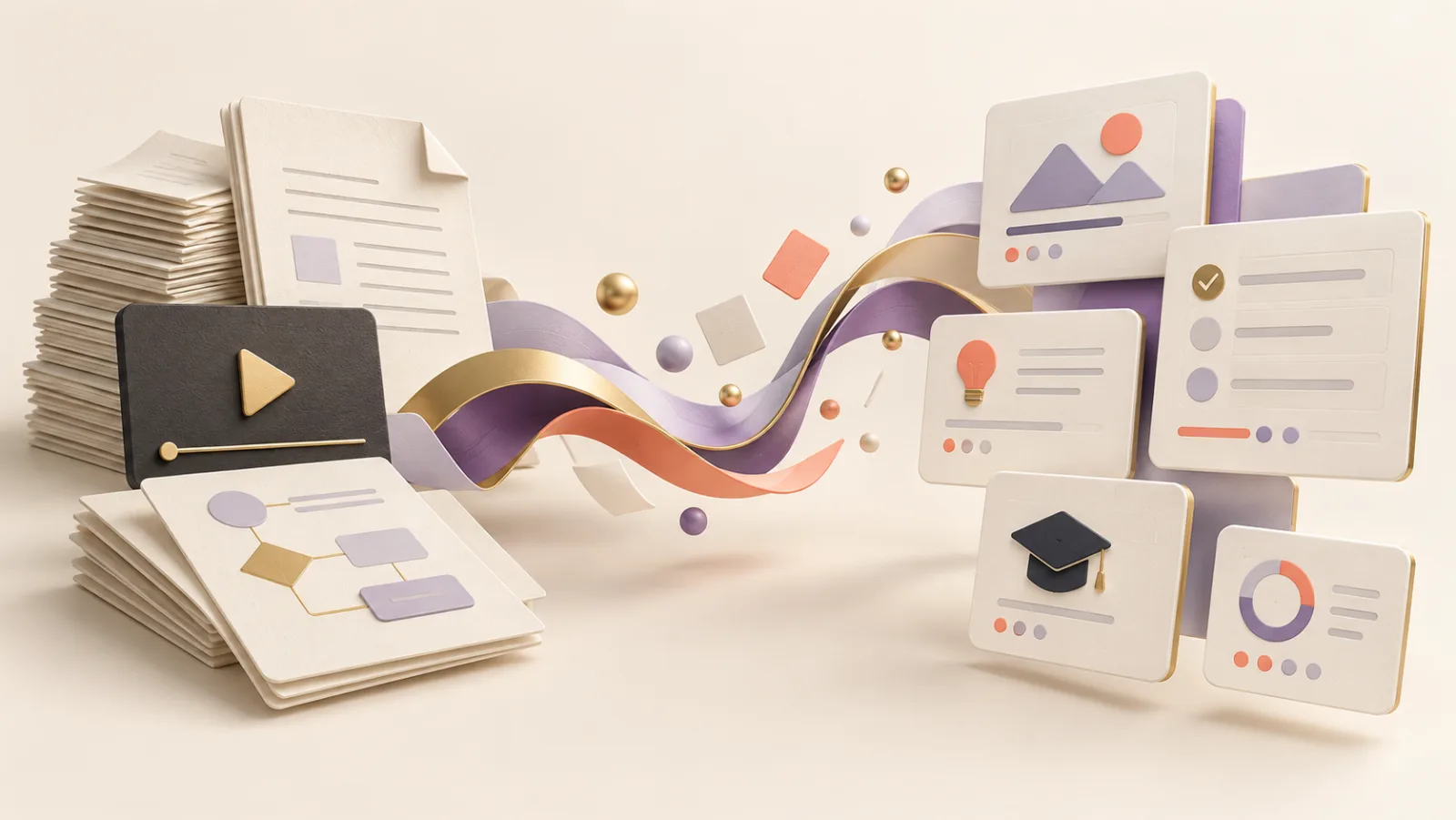
With Lurny, existing videos, documents and process guides could become the starting point for microlessons and microcourses.
Instead of asking an employee to navigate a long source file, the learning team could isolate a clear outcome: understand a change, recognise the correct process, distinguish between two treatments or remember the steps that protect quality.
01
Source
02
Microcourse
03
Quiz
04
Reinforcement
The source material could then be organised into a short sequence. A microcourse might contain a concise explanation, an example, a visual summary and a few questions to check understanding. A longer recording could be broken into focused learning moments. A process guide could remain available as the authoritative reference while a shorter lesson helped employees understand how to use it.
This gave the original content a second life. It was no longer only a file to store or a session to remember. It became reusable learning that could be assigned, revisited, assessed and updated.
Keeping pace with changes that cannot wait
When change cannot wait
Two distinct sources of change
The need becomes more urgent when professional guidance or regulatory expectations change.
Regulatory notifications
For teams working with financial processes, a new UAE Central Bank notification can affect a critical workflow or the way a requirement must be interpreted and followed.
Professional frameworks
Changes, clarifications or new interpretations relating to frameworks such as IFRS can also have practical consequences for employees responsible for accounting, audit and advisory work.
In such situations, a yearly course-update cycle is too slow. Sending the source notification alone is also insufficient. Employees need to understand what changed, why it matters to their work and what they should now do differently.
The organisations could respond by converting the relevant source material into a focused microcourse and quiz. The intervention could be targeted to the teams or roles affected by the change, rather than adding another long course to everyone’s catalogue.
The microcourse created a concise explanation. The quiz gave employees and managers an immediate indication of whether the core message had been understood. If an interpretation or process changed again, the learning could be revised without rebuilding an entire programme.
This made learning part of the response to change—not a separate activity scheduled long after the operational communication had been sent.
Small enough to update, structured enough to trust
Speed matters, but so does control.
When the subject is a critical work process or a professional framework, a microcourse cannot be a casual summary. The source must be clear. The right subject expert or process owner must review the interpretation. The learning must distinguish the authoritative notification or framework from the organisation’s practical guidance on how to respond.
Short-form learning can support this discipline because each intervention has a defined purpose. The organisation can identify the source, specify the affected audience, focus on the relevant behaviour and test the points that matter.
The result is not less rigorous because it is shorter. It is more usable because the learning has been designed around a specific change.
From passive attendance to active participation
Not every learning moment needs to happen alone at a desk.
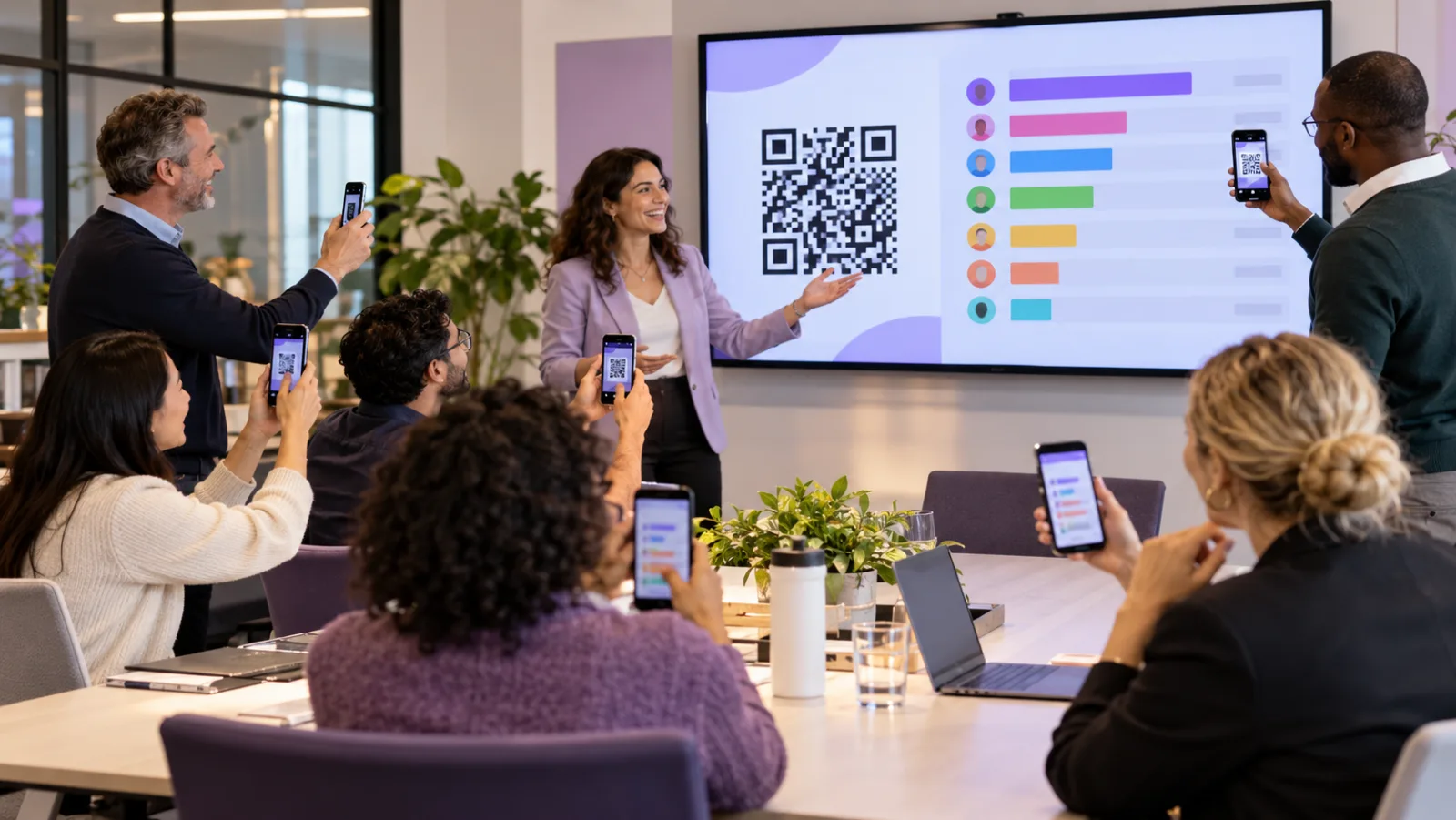
The organisations also used short quizzes during team-training sessions. Participants could scan a QR code with their phones and move directly to the quiz page in Lurny. There was no need to distribute paper, collect answer sheets or wait for the session to end before seeing how the group had responded.
How a live quiz runs
Scan to join
A QR code takes each participant’s phone straight to the quiz page.
Answer on mobile
No paper to distribute and no answer sheets to collect.
Scores update live
The room sees responses as they arrive.
Discuss the gaps
A question that divides the group becomes the next conversation.
As people answered, scores updated in real time. The shared view introduced a light element of friendly competition, but its deeper value was feedback.
The facilitator could see whether the room had understood the point just discussed. A question that divided the group could be explored immediately. A common misconception could become the next conversation rather than an issue discovered later.
For participants, the quiz made the session more active. They were not only listening; they were making a choice, seeing the result and comparing their understanding with the group.
The session does not have to end in the room
Live quizzes also created a bridge between facilitated training and ongoing learning.
The same quiz could remain available after the session. Employees who were unable to attend could complete it later. Questions that proved difficult could inform a follow-up microlesson. The facilitator no longer had to rely only on a show of hands or a general sense of whether the session had landed.
This did not turn training into a game for its own sake. It made participation visible and gave the facilitator a practical way to adjust the conversation while it was happening.
It also gave the organisation a reusable format. A subject expert could deliver a short update, invite the team into a flash quiz through a QR code and use the live responses to reinforce the important points. The learning team could then retain the microcourse and quiz for future employees or later revision.
Giving subject experts a practical route to share knowledge
In professional services, some of the most useful knowledge sits with practitioners whose primary job is not course design.
They understand the judgement behind a process. They know where teams make mistakes, which exceptions require care and which changes will have the greatest effect on clients or quality. But converting that knowledge into formal training can feel like a separate project.
By beginning with material those experts already used—videos, documents, presentations and explanations—the organisations could reduce the distance between expertise and learning.
The subject expert did not have to begin with an empty course template. The learning team could use the existing source, shape it into a concise structure, add questions and return it for review. Once approved, the intervention could be shared as a self-paced microcourse, used in a facilitated session or both.
This created a more sustainable content rhythm. Important knowledge could move from expert to employee without waiting for every topic to become a large production.
What changed
The most visible change was not the volume of content. It was the usefulness of what the organisations already had.
Existing videos and documents could be broken into focused learning rather than remaining buried in folders. Time-sensitive regulatory and professional updates could become targeted microcourses and quizzes. Team sessions could move beyond presentation and discussion to include an immediate, shared check of understanding.
Connecting the moments of learning
- An authoritative source or internal guide.
- A concise microcourse explaining what matters.
- A quiz that checks understanding.
- A live team conversation around the responses.
- A reusable learning record for reinforcement and future employees.
The story is not that every document should become a course or every meeting should have a scoreboard. It is that valuable knowledge should not become invisible simply because it began life in the wrong format.
When existing content can be reshaped quickly and used in the flow of work, learning becomes easier to keep current. And when a team can respond together, see where understanding is strong and discuss where it is not, training becomes more than content delivery.
It becomes part of how the organisation learns.